A Grateful Heart Sees the Hidden Roots

Why gratitude is not sentimentality, but clearer sight
Most people think gratitude is about being nice.
It is not.
Gratitude is about seeing more of what is real.
An ungrateful person usually notices what showed up and stops there. The meal is on the table. The ride was given. The message was answered. The bill got paid. The room feels calm. The relationship is still standing. The fruit is visible, so the fruit is all that gets counted.
But a grateful heart sees further down than that.
It sees the time underneath the meal. The patience underneath the calm tone. The restraint underneath the argument that did not get worse. The honesty underneath a trust that still exists. The repair underneath a relationship that did not collapse when it easily could have.
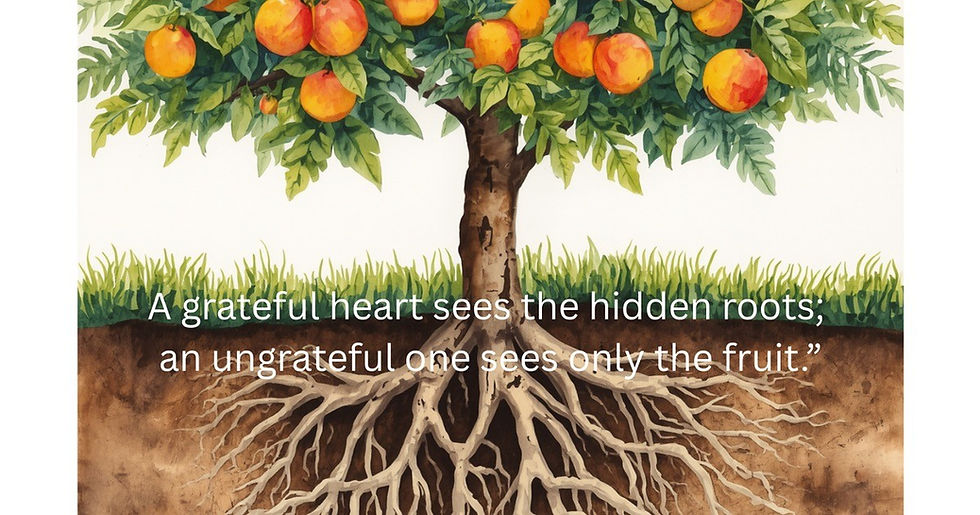
The fruit did not appear by itself.
That matters, because ingratitude is not just bad manners. Very often it is bad perception.
A person starts acting as if good things simply show up. They stop noticing effort because the result has become familiar. They stop noticing cost because the outcome is still there. What should feel like a gift starts feeling normal. Then normal starts feeling owed.
That is where distortion enters.
The dependable partner becomes “the one who always handles it." The thoughtful friend becomes “the one who is always there.” The patient parent becomes “the one who should know better.” The steady relationship becomes “just how things are,” as if it keeps itself alive.
Once a person loses sight of the roots, they start mishandling the fruit.
They become quicker to expect, slower to notice, and more careless with what another person has been carrying. They may still enjoy the benefits, but they stop responding to them with the right weight. And over time, that has effects. Respect thins. Tenderness thins. Fairness thins. The person carrying more begins to feel less seen, then less valued, then quietly alone inside what they are still giving.
That is one reason gratitude matters so much in relational life. It protects against reduction.
When you only see the fruit, people start becoming functions. The one who works hard becomes a paycheck. The one who listens becomes emotional support. The one who keeps the peace becomes the shock absorber for everyone else’s moods. The one who repairs becomes the one expected to repair.
Gratitude interrupts that flattening. It brings the person back into view.
It says: I see that this costs you something. I see that this took thought, restraint, labor, patience, discipline, memory, or sacrifice. I am not only receiving the visible result. I am seeing more of the reality beneath it.
That changes the field.
A grateful person is harder to become resentful toward, not because they are perfect, but because they keep recognizing what is actually being given. They help keep the invisible labor visible. They return some form of dignity to what might otherwise disappear into routine.
An ungrateful person does the opposite. They consume the fruit and stay blind to the roots. Then they wonder why the tree is tired.
You see this in ordinary life all the time.
Someone keeps the house running, and the other person mainly notices the one thing that was missed.
Someone works hard to make a conversation go well, and the only thing remembered is the one sentence that felt awkward.
Someone has spent years becoming safer, steadier, and more honest, and because that steadiness is now familiar, it stops being appreciated at all.
That is how ingratitude quietly erodes a bond. Not always through open contempt. Often through omission. Through failure to notice. Through living as if the fruit is natural and the roots do not matter.
Gratitude is a correction to that.
It does not mean pretending everything is wonderful. It does not mean forced positivity. It does not mean never naming what hurts, what is missing, or what still needs repair. Gratitude is not dishonesty. It is fuller honesty.
It says: yes, I can see what is hard here. And I can also see what has been given, what has been carried, and what has been made possible.
That kind of seeing makes a person different.
They become less entitled. Less careless. Less likely to treat another person’s constancy as background noise. They become easier to live with because they are actually responding to more of reality, not less.
And there is an inward effect too.
A grateful heart tends to stay softer. It is less hungry in the wrong way. Less aggrieved by default. Less likely to move through life acting cheated when it is, in fact, being sustained by many things it did not create alone.
An ungrateful heart hardens. It starts scanning for what is missing while overlooking what is present. It becomes harder to satisfy because it has lost contact with the hidden roots of so much of what makes life livable.
That is why this is not a small virtue. It changes what kind of person someone becomes.
In the language of Matthew 29, gratitude helps keep a person in contact with truth. It sees more accurately. It resists reduction. It honors personhood. It helps protect fairness, because it remembers that visible benefits usually rest on invisible costs. And it makes trust easier to maintain, because what is carried in love is more likely to be recognized before it turns into silent strain.
A grateful heart sees the hidden roots.
An ungrateful one sees only the fruit.
One lives closer to reality. The other lives on the surface of it.


Comments